Sign in. It’s quick, free and it’s up to you.
An account is an optional way to support the work we do. Find out more.
Sign in. It’s quick, free and it’s up to you.
An account is an optional way to support the work we do. Find out more.

A PUZZLING STATEMENT, made by an official X account for US Republican lawmakers, has falsely claimed that the EU had “fined X €45 million after concluding people would think Donald Duck was a real person”.
The EU did fine X but for breaching the law governing large social media providers.
Specifically, X was charged €45 million for breaching the EU’s Digital Services Act by deceiving users for years about the “verified” status feature.
Additional fines of €35 million and €40 million were imposed on X for failing in its obligations to share data with the public or researchers.
“Can’t make this up,” a 28 January post by the Republican House Committee on the Judiciary begins. “The EU fined X €45 million after concluding people would think Donald Duck was a real person.”
That post was viewed 32 million times. A reshare of it posted by Elon Musk, the owner of X and former part of the current Republican administration, was viewed 31 million times.
The judiciary committee’s post linked to a long thread outlining the case, which they said fined X “for defending free speech” under “an Orwellian online censorship law—the Digital Services Act”.
“The Commission even gave an example of what it found so objectionable: a blue checkmark on a Donald Duck parody account,” their post read. “That’s right—the Commission fined X €45 million because its practices might lead users to believe that 1) this fictional duck had come to life, and 2) was a real X user.”
Helpfully, a link to the actual decision by the European Commission was also provided in that thread, though it shows something far different that what the Republican judiciary committee described.
Instead, the finding said that X was:
Deceptively designing, organising and operating X’s online interface in relation to the ‘verified’ status feature of that service in a manner that materially distorts or impairs the ability of recipients of that service to make free and informed decisions regarding the authenticity and reliability of accounts on that service.
“Such non-compliance has commenced on 28 August 2023 and is ongoing,” the commission’s finding read.
Donald Duck does make an appearance in the document, but there is no suggestion that people could be tricked into thinking he was a real person.
“Figure 2: Example of the textual and visual online interface design granted to X Premium subscribers,” reads the caption of the image.
Donald Duck does not appear elsewhere in the 183-page ruling, nor is the character mentioned in any of the arguments that X had broken the law.
The paragraph preceding the screenshot says that the purpose of the screenshot is to compare the “verified” blue tick beside names from before Musk’s takeover, with the “premium” blue tick he introduced.
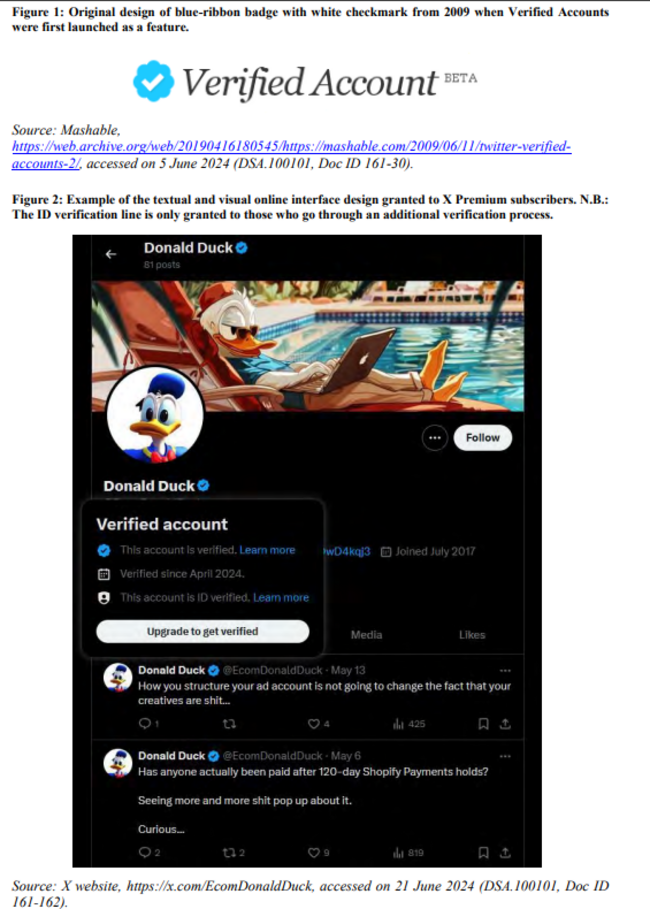
The screenshot is intended to showcase how accounts generally look on the platform, not any information about the specific account.
“For users subscribed to X’s Premium and Premium+ services, X’s online interface displays virtually the same blue-ribbon badge next to the username as that previously available under Twitter’s Verified Accounts system,” the finding reads.
It also notes that premium accounts were still being described as being “verified”, despite the vetting standards being “dismantled”.
However, the written arguments do mention real-life examples of “widely reported high-profile impersonations, including public figures such as Donald Trump, Rudy Giuliani and LeBron James, and companies such as Eli Lilly and Valve”.
The scandal involving Eli Lilly, a company worth hundreds of billions, was perhaps the most high profile. Shortly after Elon Musk took over X (previously called Twitter), new rules to the “verified” system meant that a fake account for Eli Lilly was given a blue check mark. It posted: “We are excited to announce insulin is free now”.
The company’s stock abruptly fell by 4.37%.
Ultimately, the commission found that X “deceives recipients of the X service into believing that accounts with a ‘verified’ status on X are meaningfully vetted by that provider, thereby materially distorting or impairing their ability to make free and informed decisions regarding the authenticity and reliability of those accounts”.
The Journal’s FactCheck is a signatory to the International Fact-Checking Network’s Code of Principles. You can read it here. For information on how FactCheck works, what the verdicts mean, and how you can take part, check out our Reader’s Guide here. You can read about the team of editors and reporters who work on the factchecks here.

To embed this post, copy the code below on your site
















have your say